Indoor vs outdoor pickleball balls, compared
Outdoor pickleball balls have 40 small holes, harder plastic, and more weight so wind can't push them around. Indoor balls use 26 larger holes and softer plastic, so they fly slower and sit up higher on the bounce. The indoor vs outdoor pickleball balls choice comes down to surface and wind.
Indoor vs outdoor pickleball balls, side by side
Both types clear the same standards. The differences live inside that window, and you feel them on the first serve.
| Indoor ball | Outdoor ball | |
|---|---|---|
| Holes | 26, larger | 40, smaller |
| Plastic | softer, more flex | harder, more brittle |
| Weight | low end of the legal range | high end of the legal range |
| Flight | slower, drops sooner | faster, flatter |
| Bounce | sits up | skids low |
| Spin | grips the paddle face | slides off the harder surface |
| Sound | duller thud | sharp crack |
| How it dies | goes soft, warps out of round | cracks or splits |
| Rough life | weeks of regular play | a handful of sessions |
Pickleball ball weight, hardness, and bounce
USA Pickleball writes one ball spec, not two. A legal ball measures 2.874 to 2.972 inches across, weighs 0.78 to 0.935 ounces, and bounces 30 to 34 inches when dropped from 78 inches onto granite at 75 to 80°F. Hardness runs 40 to 50 on the Durometer D scale, and there's an out-of-round tolerance, so a warped ball is outside spec rather than just irritating.
That legal pickleball ball weight range is wider than it looks — the heaviest legal ball is roughly 20% heavier than the lightest — and the spread is basically the indoor/outdoor split. A couple of tenths of an ounce separates a ball that bores through a crosswind from one that gets nudged off line.
How many holes in a pickleball
Anywhere from 26 to 40, and both ends are legal — the rulebook calls for evenly spaced circular holes in that range. Manufacturers took the extremes and made them the convention: 40 smaller holes outdoors, 26 larger ones indoors. More small holes plus stiffer plastic means less drag and more mass behind the ball. Fewer, bigger holes bleed off speed, which is why an indoor ball feels like it hangs in the air.
Why do pickleballs have holes
The game was invented in 1965 on Bainbridge Island, Washington, with a perforated plastic ball, and the holes stayed because they solve a real problem. A solid ball that size would fly too far and too hot for a court that's 20 by 44 feet. The perforations dump speed and shorten the flight, which is what makes dinks and drops possible at all — the court's measurements explain why.
What each ball does to a rally
An outdoor ball comes off the paddle fast and skids low off rough acrylic. Its hard surface grips less, so heavy topspin does less than you'd expect, and drives get through the court before opponents reset. Rallies run shorter. Cold makes the plastic brittle — splits get routine once it's in the 40s or low 50s °F.
An indoor ball plays like a slower version of the same game. The softer plastic bites the paddle face, so spin holds, and the bigger holes drag it down, so drops land softer and rallies stretch out. It softens further as it warms up, which makes a long evening gradually slower.
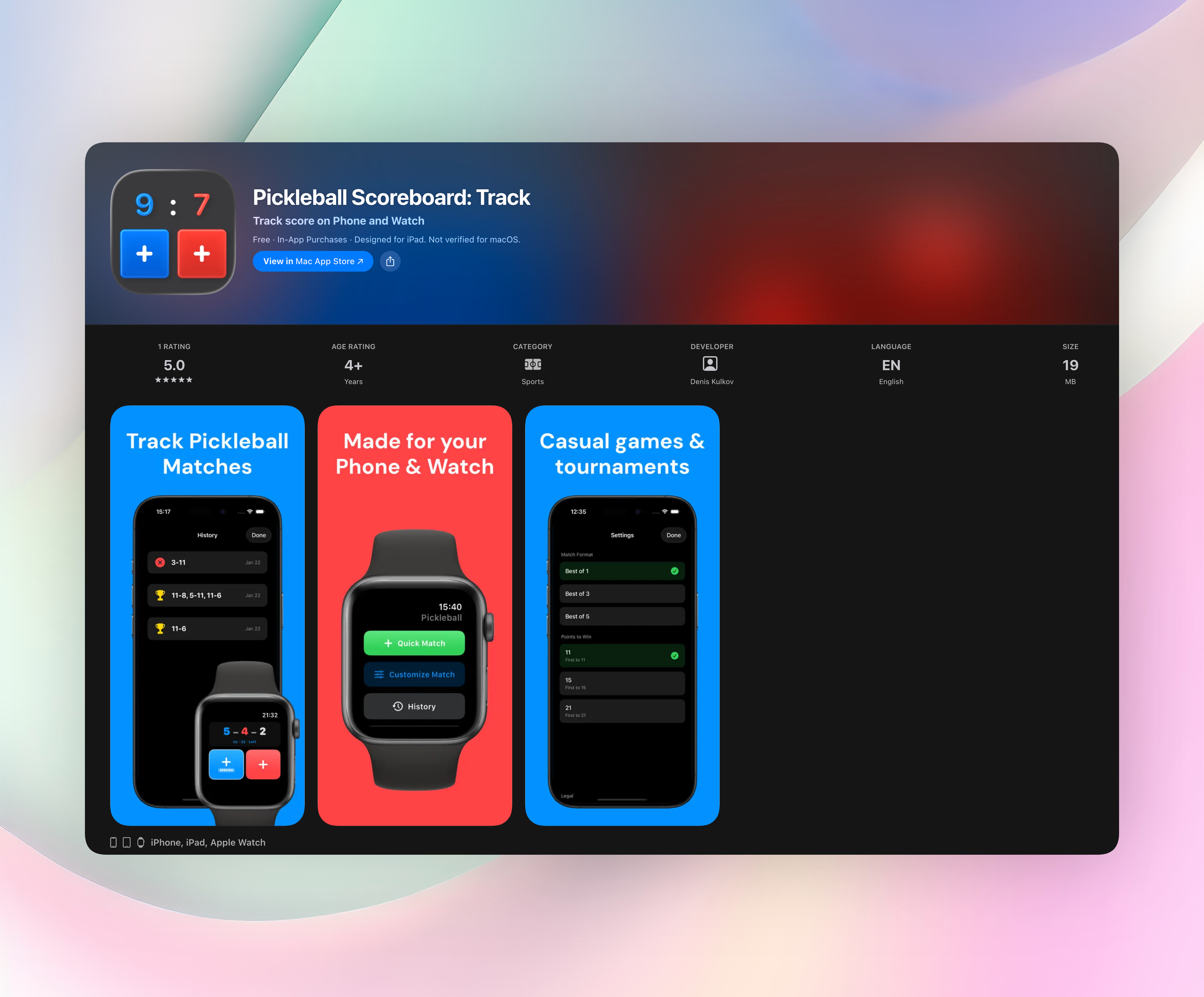
Switching between the two changes rally length more than most players expect, and it's easy to blame your form for what the ball is doing. Logging matches session by session makes the shift obvious — Pickleball Scoreboard is a pickleball scoreboard app for iPhone and Apple Watch that tracks match scores, so a week of indoor games sits next to your outdoor ones.
Playing a pickleball ball indoor vs outdoor
Most of the indoor vs outdoor pickleball ball confusion shows up when someone brings the wrong one. Take an indoor ball outside and two things go wrong: wind moves it, because it's light with large holes, and the abrasive surface chews the soft plastic — scuffs first, then a wobble, sometimes inside one session.
Outdoor balls indoors is the more common mistake. On a smooth gym floor the hard plastic skids and stays low, and the sharp bounce that a rough court tames turns hard to control and loud enough to bother the next court over. It's playable. It just isn't the game the room was set up for.
How to tell a ball is done
- Roll it slowly across a flat floor. Out of round, it wobbles or curves.
- Squeeze it. Any soft spot means the plastic is fatigued.
- Listen. A dead ball thuds instead of cracking off the paddle.
- Check around the holes and along the seam, where hairline cracks start.
- Drop it beside a fresh ball from the same height. A tired ball comes up short.
Outdoor balls are consumables — a few sessions of hard play is a normal life, and in the cold a single session can end one. Indoor balls last far longer, often weeks of regular play, and they rarely crack. They go soft and lose bounce instead, which is easier to miss.
Why tournaments name a specific ball
USA Pickleball keeps an approved ball list, and events name the exact model they'll use. Two balls can both be legal and still play differently: one flies harder off the paddle, another holds its bounce longer in heat. Naming the model means everyone competes on something they could practice with first, so find it in the entry information and train with it. The rest of the equipment requirements sit alongside the official rules of play.
FAQ
Can I use an outdoor ball indoors?
You can, and nothing in the rules stops you, but it skids low on a smooth floor, plays faster, and is louder. Dinks and drops that normally sit up will die at your feet. Fine for a casual game, poor for working on soft-game touch.
How many holes does an indoor pickleball have?
26, and they're larger than the holes on an outdoor ball, which has 40 smaller ones. Both counts are legal — the rulebook allows anywhere from 26 to 40 circular holes.
Why do pickleballs have holes instead of being solid?
The design came from the perforated plastic ball the game started with in 1965. Holes cut speed and distance so rallies stay controllable on a short court, and the pattern keeps flight consistent enough that touch shots repeat.
How much does a pickleball weigh?
Between 0.78 and 0.935 ounces (roughly 22 to 26.5 grams) to be legal. Indoor balls tend to sit near the light end of that range and outdoor balls near the heavy end.
How long does an outdoor pickleball ball last?
A few sessions of hard play is typical, and cold weather shortens that considerably. Replace it when it cracks, wobbles on a slow roll, or stops bouncing as high as a new ball from the same drop height.
Free Pickleball tools
- Pickleball Beginner Drill PlannerBuild a practical session for pickleball drills for beginners. Choose players, practice time and a focus area to get a timed sequence.
- Pickleball Net Setup ReferenceConvert pickleball net dimensions and get a practical setup checklist for the centre, posts and court placement.
- Pickleball Rating CalculatorAnswer seven short questions about your match play to get an estimated pickleball rating, the matching skill description and two skills to work on next.
- Pickleball Warm-Up PlannerBuild a simple pickleball warm-up routine for your available minutes, player level and number of players.
- Printable Pickleball Rules CardChoose scoring, game length, format and sections to make a printable pickleball rules card for the court or your phone.
- Pickleball Round Robin GeneratorCreate a round-by-round pickleball schedule with court assignments and sit-outs, then print a clean score sheet for play.
- Tennis Court to Pickleball Conversion CalculatorEnter a tennis court or any available area to see how many pickleball courts fit, where to mark the lines and how much clearance remains.
- Pickleball Tournament Bracket GeneratorBuild a pickleball tournament bracket from team names or a team count. Choose single or double elimination, set your seeding, then print and run the bracket in your browser.