How many points to win pickleball — 11, 15, and 21 explained
A standard pickleball game goes to 11 points, win by 2. Tournaments also use single games to 15 or 21 with the same two-point margin. Rec play almost always uses 11, and matches are usually best two of three.
How many points to win pickleball, by format
All three targets are legal under the USA Pickleball rulebook. Which one you play is set by the tournament director, the league, or whoever booked the court.
- Games to 11 — USA Pickleball's primary recommendation and the rec-play default, normally best two of three.
- A single game to 15 — the standard way to compress a bracket when the schedule is tight.
- A single game to 21 — the least common of the three, still seen in social leagues and some round robins.
All three are win by 2.
Under traditional side-out scoring, only the serving team can score, so the target number says little about how many rallies a game takes — two evenly matched teams can play a longer 15-point game than a lopsided one to 21. If that sequence is still fuzzy, read through pickleball scoring in full.
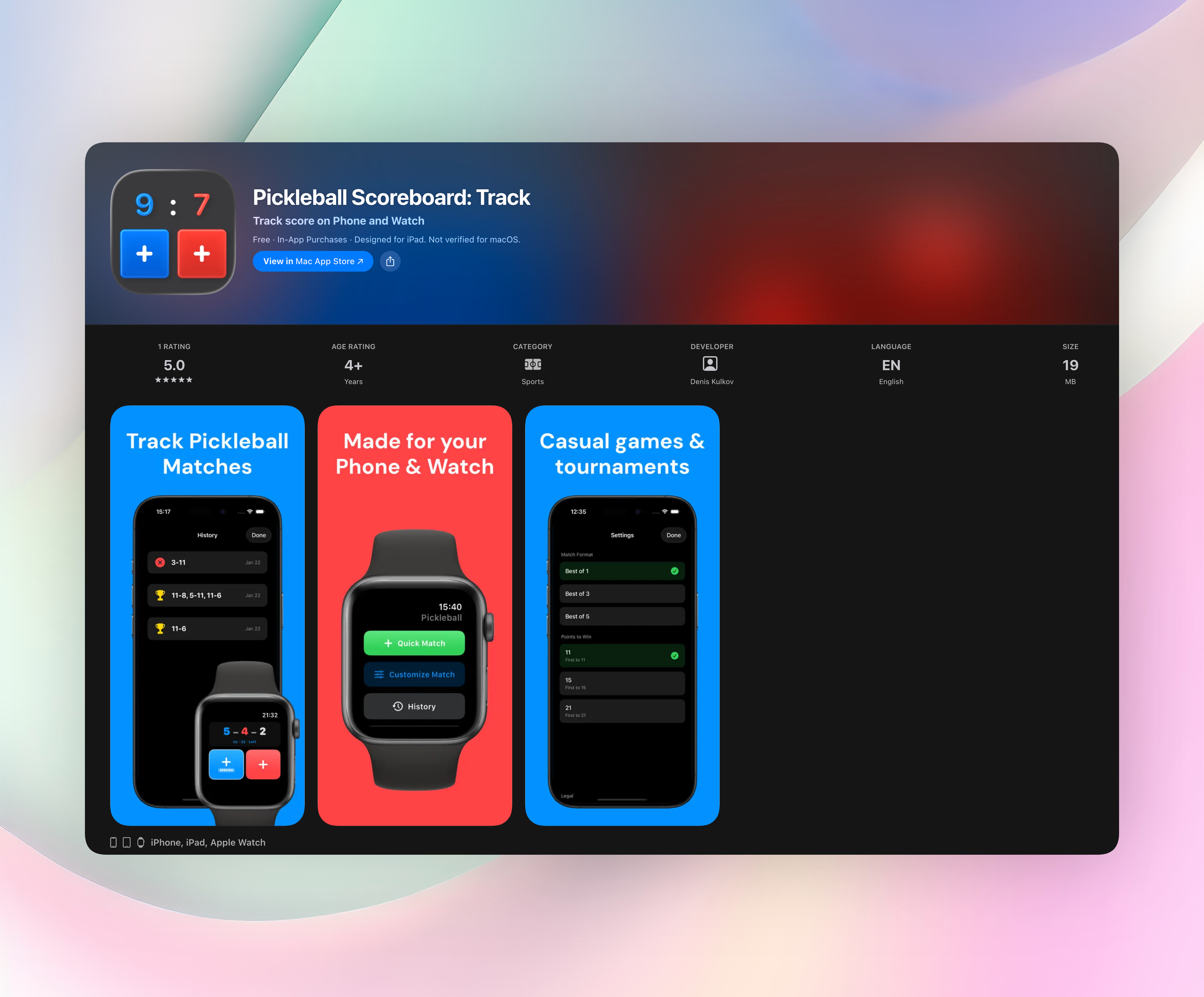
Settle the target before the first serve — "to 11" and "to 15" are different games, and plenty of court arguments start with two people assuming different numbers. Pickleball Scoreboard is a pickleball scoreboard app for iPhone and Apple Watch that tracks match scores, which helps when a game runs long past the target and nobody's sure where it got to.
Why win by 2 makes game length unpredictable
Reaching the target isn't enough — you need a two-point margin. At 10-10 in a game to 11, play continues until one side leads by two: 12-10, 13-11, and onward. Standard USA Pickleball rules put no cap on that.
Side-out scoring stretches those endings further: the trailing team can't score until it wins the serve back, so a 10-10 game can pass through several side-outs before the score moves once. Five or ten extra rallies at the end of a tight game is normal.
Some leagues add a local cap — a game to 11 capped at 15, first side there wins regardless of margin. That's a house rule, not a rulebook rule, so ask before the match, not at 14-14. Same goes for rally scoring, which lets either team score on any rally and tends to shorten games.
Switching ends
End changes keep sun and wind from sitting on one side all match. Every format has one, including a single game to 11:
- Single game to 11 — change ends when the first side reaches 6.
- Single game to 15 — change ends at 8.
- Single game to 21 — change ends at 11.
- Best two of three to 11 — change ends after each game, and at 6 in the deciding third game.
A mid-game switch gets one minute; the break between games is two. The serve stays with whoever holds it and the score carries over — you're only trading ends.
How long is a pickleball game
Working estimates for club-level doubles, side-outs and format breaks included. All win by 2.
| Format | Target score | Mid-game end change | Plan for |
|---|---|---|---|
| Single game to 11 | 11 | At 6 | 15–25 min |
| Best two of three to 11 | 11 per game | At 6 in game three | 45–75 min |
| Single game to 15 | 15 | At 8 | 20–30 min |
| Single game to 21 | 21 | At 11 | 30–45 min |
Time-outs belong in the budget. Each side gets two one-minute time-outs in a game to 11 or 15 and three in a game to 21, plus a two-minute break between games — a fully used best-of-three absorbs around fifteen minutes of legal stoppage. Book an hour for a best-of-three to 11, or 90 minutes if a third game looks likely. A rec rotation with 11-point games gets through three or four games an hour per court.
Pickleball tournament formats and scoring
The format often changes by round, and sometimes by bracket size. Round robin pools of six or more teams may be run as a single game to 11 instead of best two of three, and in double elimination the backdraw commonly drops to one game to 15 to hold the schedule. Tournament scoring is published on the event page — read it before you drive out.
Round robin format
In a pickleball round robin format, every team in the pool plays every other team and standings come from matches won. Ties are broken by a fixed sequence in the rulebook rather than a playoff: head-to-head record among the tied teams first, then point differential, and further down, total points scored. Points scraped together in a match you're already losing can decide whether you advance.
Brackets and provisional formats
Double elimination is the usual bracket: a first loss drops you to the backdraw rather than out. Rally scoring is still provisional in sanctioned play and isn't allowed everywhere — double-elimination doubles events, USA Pickleball Golden Ticket events, and the National Championships use side-out scoring. Read the format sheet as carefully as you'd read the pickleball rules.
FAQ
How many points do you need to win a pickleball game?
Eleven, with a margin of at least two. At 10-10, play continues until one side is two clear. Tournament games to 15 or 21 use the same margin.
Can a pickleball game end 11-10?
No. A one-point lead isn't enough at the target, so the game continues past 11 until someone leads by two. An 11-10 scoreline means the game is still on.
How long is a pickleball game?
A single game to 11 in club doubles usually takes 15 to 25 minutes; a best-of-three runs roughly 45 to 75 minutes with breaks. Skill level matters more than the target score, since longer rallies stretch every point.
When do you switch sides in pickleball?
At the midpoint of a single game — 6 in a game to 11, 8 in a game to 15, 11 in a game to 21. In a multi-game match you change ends after each game, plus at 6 in the deciding game.
Is there a cap on how high the score can go?
Not under standard rules — a game to 11 could in theory run to 20-18. Some leagues impose a house cap, often 15 in an 11-point game, but that's a local decision worth confirming before you start.
Free Pickleball tools
- Pickleball Beginner Drill PlannerBuild a practical session for pickleball drills for beginners. Choose players, practice time and a focus area to get a timed sequence.
- Pickleball Net Setup ReferenceConvert pickleball net dimensions and get a practical setup checklist for the centre, posts and court placement.
- Pickleball Rating CalculatorAnswer seven short questions about your match play to get an estimated pickleball rating, the matching skill description and two skills to work on next.
- Pickleball Warm-Up PlannerBuild a simple pickleball warm-up routine for your available minutes, player level and number of players.
- Printable Pickleball Rules CardChoose scoring, game length, format and sections to make a printable pickleball rules card for the court or your phone.
- Pickleball Round Robin GeneratorCreate a round-by-round pickleball schedule with court assignments and sit-outs, then print a clean score sheet for play.
- Tennis Court to Pickleball Conversion CalculatorEnter a tennis court or any available area to see how many pickleball courts fit, where to mark the lines and how much clearance remains.
- Pickleball Tournament Bracket GeneratorBuild a pickleball tournament bracket from team names or a team count. Choose single or double elimination, set your seeding, then print and run the bracket in your browser.