Pickleball vs tennis: what actually changes when you switch
Pickleball vs tennis comes down to five things: a court about a third the size, a net two inches lower at the center, an underhand-only serve, a two-bounce rule that kills serve-and-volley, and scoring that shares no vocabulary with tennis. Most tennis instincts transfer. Three of them actively hurt.
Pickleball court vs tennis court: about a third of the space
A pickleball court is 20 by 44 feet — the same rectangle as a doubles badminton court — and it doesn't change size for singles. A tennis court is 78 feet long and 36 feet wide for doubles, 27 for singles. Roughly 880 square feet against about 2,800.
The pickleball court vs tennis court gap carries into the service boxes: each is 10 feet wide and 15 feet deep, so there's far less room to angle a serve away from the returner.
Pickleball net height vs tennis, and the kitchen
Pickleball nets are 36 inches at the sidelines and 34 at the center; tennis is 42 at the posts and 36 at the center. Both dip in the middle, but pickleball's low point sits two inches under tennis's, across a court a little over half as wide.
Then there's the non-volley zone, the kitchen: 7 feet back from the net on both sides, the full 20-foot width. You can stand in it; you just can't volley from it, and your momentum can't carry you in after one. Tennis has no equivalent, which is why switchers commit foot faults they never learn to feel. Read the kitchen rules before your first game.
The serve and the two-bounce rule
Pickleball serves are underhand. On a volley serve, contact has to be below your waist — measured at navel level — with the paddle head below the highest part of your wrist and the arm moving upward. USA Pickleball added the word "clearly" to all three requirements for 2026, so borderline serves no longer get the benefit of the doubt.
The alternative is the drop serve: let the ball fall without adding force, let it bounce, then hit it however you like. You get one attempt — there is no second serve — and a serve that clips the net and lands in stays live. It goes cross-court and must clear the kitchen; landing on the non-volley zone line is a fault, though the other service-court lines are good.
The bigger shock is the two-bounce rule, also called the double bounce rule: the serve has to bounce, the return has to bounce, and only then can anyone volley. Serve-and-volley isn't a weak tactic here, it's a fault. Replacing it is the third-shot drop, a soft ball arced into the kitchen that buys the serving team time to reach the line.
Scoring: two systems that share no words
Tennis counts love, 15, 30, 40, then games and sets. Pickleball plays to 11, win by 2 — tournaments sometimes use 15 or 21 — and under traditional side-out scoring only the serving team can score. In doubles the server calls three numbers out loud before every serve: their team's score, the opponents' score, and whether they're the first or second server. "Four, two, one." Singles drops the third number. USA Pickleball also runs rally scoring as a provisional format, where every rally scores; for 2026 the receiving team can take the game-winning point, which the 2025 rules didn't allow. Both are covered in the guide to pickleball scoring.
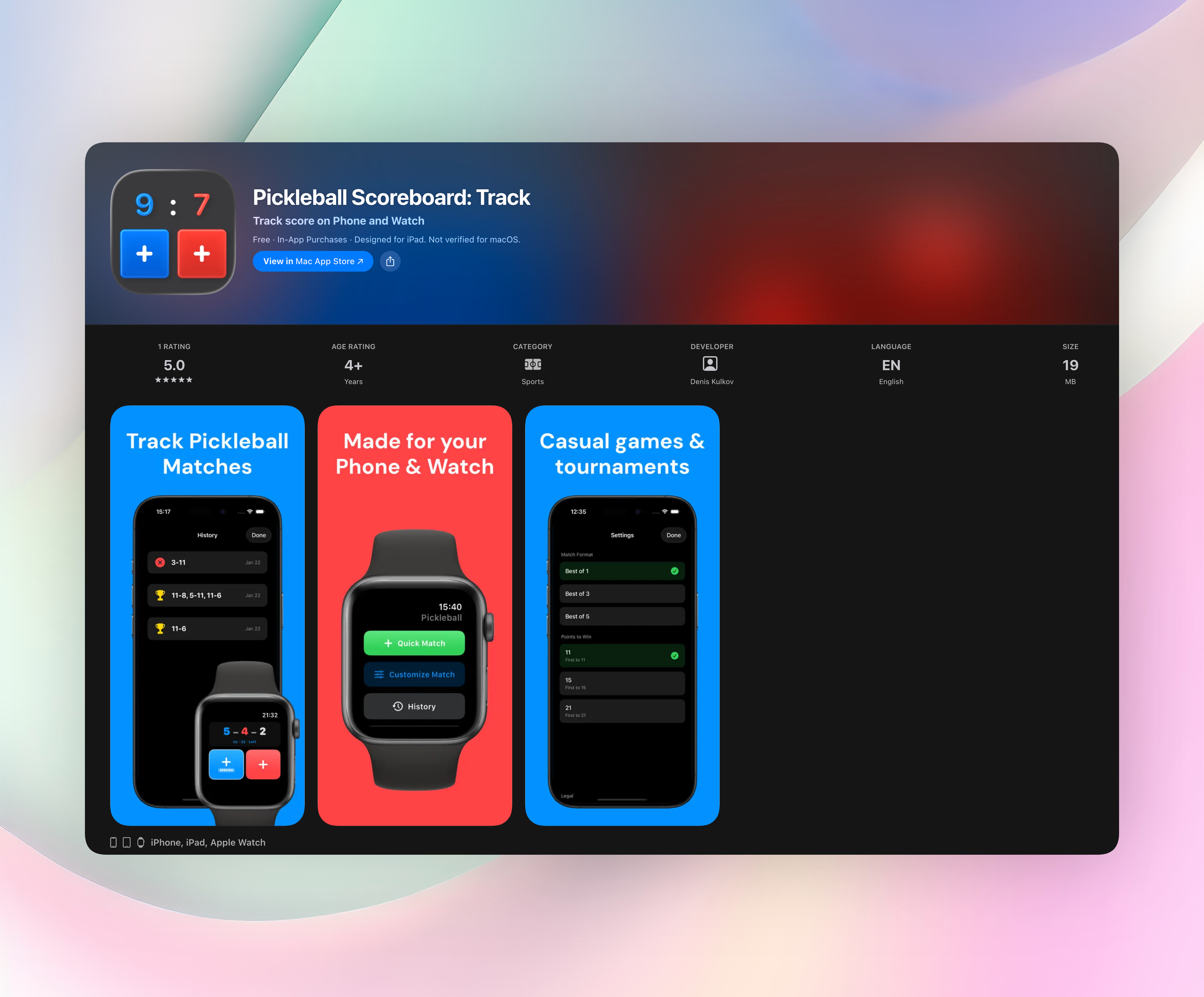
Holding that call in your head while tracking which side you belong on is where new players lose the thread. Pickleball Scoreboard is a pickleball scoreboard app for iPhone and Apple Watch that tracks match scores, which settles the argument about whether it was 6–4 or 6–5.
Pickleball vs tennis at a glance
| Element | Pickleball | Tennis |
|---|---|---|
| Court | 20 × 44 ft, singles and doubles | 27 × 78 ft singles, 36 × 78 ft doubles |
| Net height | 36 in sidelines, 34 in center | 42 in posts, 36 in center |
| Non-volley zone | 7 ft from net, each side | None |
| Serve | Underhand, one attempt | Any motion, two attempts |
| Ball | Perforated plastic, 2.87–2.97 in | Pressurized felt, 2.57–2.70 in |
| Implement | Solid paddle, no strings, 17 in max | Strung racket, 29 in max |
| Scoring | To 11, win by 2; side-out or rally | Games and sets, love–15–30–40 |
Is pickleball easier than tennis? Easier to start, not easier to win
Tennis's barriers for a beginner are the overhead serve and the running. Pickleball removes both: the serve is underhand by rule, and two people cover 880 square feet. Most first-timers sustain a rally within an hour, which rarely happens on a tennis court.
What replaces them is a game with no margin. Dinks have to land in a box seven feet deep, resets have to die at your opponent's feet, and points go to whoever stays patient longest. Power is the least useful thing a tennis player brings.
Tennis habits that transfer, and three that hurt
Ball tracking, volley hands, and doubles instinct move over intact. Most exchanges happen seven feet from the net, so reading a ball early matters even more here. Poaching, holding a line with a partner, and the split step all carry over.
The full swing. A topspin forehand produces more paddle-head speed than a 44-foot court can absorb, and perforated plastic takes far less spin than felt. The ball you expect to dip lands three feet long.
Following your serve in. You have to let the return bounce, so running forward only strands you in the transition zone, hitting off your shoelaces.
Treating the baseline as home. In tennis the baseline is where you live. Pickleball inverts that: the kitchen line is the winning position, and anyone camped at the baseline gets dinked apart.
Pickleball vs padel and pickleball vs paddle tennis
Pickleball vs padel. Padel is played on an enclosed court, 20 by 10 meters — about 66 by 33 feet — where the glass and mesh walls are in play. The net is 88 cm at the center, within an inch of pickleball's. The serve is underhand, but the ball has to bounce first and be struck at or below waist height, and you get two attempts. Scoring is tennis's, and competition is doubles.
Pickleball vs paddle tennis. Paddle tennis, rebranded POP tennis in the US, is the closest to shrunken tennis: a 50-by-20-foot court, a net at least 31 inches high, an underhand serve, a depressurized tennis ball, tennis scoring. No walls, no kitchen. It isn't platform tennis, played on a heated elevated deck where the screens are in play.
FAQ
Can you play pickleball on a tennis court?
Yes. One tennis court fits up to four pickleball courts with portable nets and taped lines. Play over the tennis net instead and its center sits at 36 inches, two above the pickleball standard — fine for rec, not for anything sanctioned.
Is pickleball easier than tennis for beginners?
Easier to start. The underhand serve and the small court mean most people rally on day one. Getting good is a separate problem: the soft game rewards touch and patience, which take as long to build as a tennis forehand.
Why can't you volley the return of serve in pickleball?
The two-bounce rule requires the serve and the return to bounce before anyone volleys. It blunts the serving team's advantage, and it's why serve-and-volley doesn't exist here.
Does playing pickleball hurt your tennis game?
Partially. Volleys, reflexes, and doubles positioning move in both directions; full groundstroke swings don't. Pickleball trains a shorter stroke, and tennis wants the long one back.
Free Pickleball tools
- Pickleball Beginner Drill PlannerBuild a practical session for pickleball drills for beginners. Choose players, practice time and a focus area to get a timed sequence.
- Pickleball Net Setup ReferenceConvert pickleball net dimensions and get a practical setup checklist for the centre, posts and court placement.
- Pickleball Rating CalculatorAnswer seven short questions about your match play to get an estimated pickleball rating, the matching skill description and two skills to work on next.
- Pickleball Warm-Up PlannerBuild a simple pickleball warm-up routine for your available minutes, player level and number of players.
- Printable Pickleball Rules CardChoose scoring, game length, format and sections to make a printable pickleball rules card for the court or your phone.
- Pickleball Round Robin GeneratorCreate a round-by-round pickleball schedule with court assignments and sit-outs, then print a clean score sheet for play.
- Tennis Court to Pickleball Conversion CalculatorEnter a tennis court or any available area to see how many pickleball courts fit, where to mark the lines and how much clearance remains.
- Pickleball Tournament Bracket GeneratorBuild a pickleball tournament bracket from team names or a team count. Choose single or double elimination, set your seeding, then print and run the bracket in your browser.