What your DUPR rating actually measures
Your DUPR rating is a number between 2.000 and 8.000 that estimates your pickleball level from recorded match scores. It moves on point differential and opponent strength, not wins alone. DUPR stands for Dynamic Universal Pickleball Rating, and doubles and singles are rated separately.
What a DUPR rating measures, and what it doesn't
DUPR is an open rating system — accounts are free and every rating is visible. The number carries three decimals, so you'll see 3.472 rather than "about a 3.5." That precision exists because the algorithm nudges the figure by hundredths after most matches.
What it measures is your recent results against rated opponents. What it doesn't measure is how clean your dinks look, how many years you've played, or what your club calls you. The rating is an estimate the system keeps revising, and it's normal for it to drift down when you start entering stronger fields.
Two things surprise new users. The floor is 2.000, so a beginner and an absolute beginner look identical on paper. And the ceiling is theoretical — the best players in the world top out in the high 6s and low 7s, which leaves the top of the range as headroom nobody uses.
How the DUPR rating scale moves: point differential, not just wins
Before a match, the algorithm has an expectation based on the ratings on court. Afterward it compares the actual score against that expectation. Beat expectation and you gain; fall short and you lose ground — win or lose.
That has consequences worth internalizing:
- Losing 11–9 to a team half a point above you can raise your rating.
- Winning 11–9 against a team well below you can lower it.
- Beating much weaker opponents is nearly worthless, because the expected margin was already lopsided.
- Blowout losses cost more than close ones, so grinding a 2–9 game back to 9–11 is not pointless.
Recent results also carry more weight than old ones, so the number tracks the player you are now rather than the one you were two seasons ago. And because margin is the input, the exact score matters, not just who won. If the format itself is still fuzzy, how pickleball scoring works is the prerequisite.
DUPR vs the 2.0–5.0 skill ladder and UTPR
Three different instruments get called "a rating" in the same conversation.
The familiar skill ladder — 2.0, 2.5, 3.0, on up to 5.0+ — is self-assessed. You read a paragraph of descriptions and pick the one that sounds like you. It's coarse, it's optimistic, and it almost never goes down. Most clubs still sort open play with it.
UTPR, the USA Pickleball Tournament Player Rating, is calculated rather than claimed, but it draws only on sanctioned tournament results and is driven by who won. Play no sanctioned events and it doesn't move.
DUPR accepts any verified match — league night, club ladder, sanctioned tournament, or a recorded rec game — and reads the margin. It moves in both directions, and it's the same number everywhere.
So "I'm a 3.5" and "my DUPR is 3.5" are unrelated statements. It's routine for a confident self-rated 3.5 to settle in the low 3s once real scores get counted. The self-rating was a description; the DUPR is a measurement.
DUPR rating chart: what each band looks like on court
Bands blur at the edges, and a 3.499 plays like a 3.500. Read this as a map, not a verdict.
| DUPR band | What it looks like on court | Where it breaks down |
|---|---|---|
| 2.000–2.499 | Learning the serve and return; rallies end in a shot or two; play stays at the baseline | Serve consistency and returning a deep serve — start here |
| 2.500–2.999 | Serve and return land regularly; moving up after the return; dinks clear the net but sit up | Getting to the non-volley zone line and staying there |
| 3.000–3.499 | Sustains rallies; holds the kitchen line; strings several dinks together; third shot is usually a drive | Anything above net height gets put away against them |
| 3.500–3.999 | Lands third-shot drops a fair share of the time; stacks and switches on purpose; works cross-court dink patterns | Speed-ups at the body; drops float under pressure |
| 4.000–4.499 | Resets from mid-court; picks the right ball to attack; hunts the weaker player and the backhand | Long dink exchanges against a patient team; unforced errors |
| 4.500–4.999 | Reliable resets, disciplined shot selection, deliberate changes of pace; wins open brackets | Only against genuinely elite hands and speed |
| 5.000+ | High-level amateur through professional; errors are rare and points get won, not given | — |
The vocabulary in that table is worth knowing precisely — reset, third-shot drop, stacking — and the pickleball terms glossary covers it.
How to get a pickleball rating with DUPR
- Create a free DUPR account and get your DUPR ID.
- Make sure everyone in the match has one. Unrated players can't feed the algorithm.
- Record the match with the exact game scores, not just the winner.
- Have the other side confirm it. Unverified entries count for less, or for nothing.
- Or let an organizer handle it — DUPR-affiliated leagues, clubs, and tournaments upload results directly.
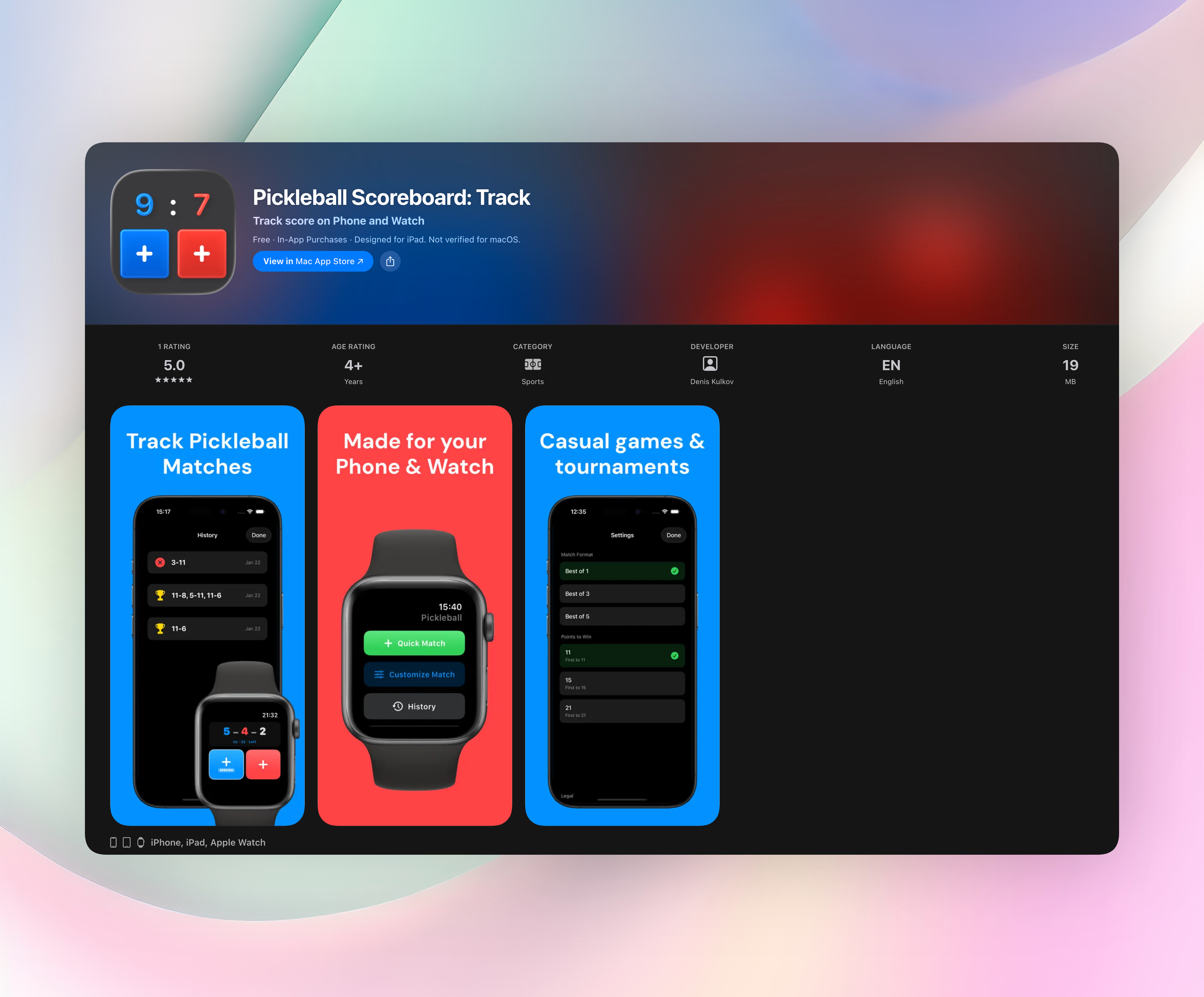
Step three is where rec players lose their rating. By the time anyone opens an app, the afternoon has collapsed into "we won two of three," and a match nobody recorded accurately might as well not have happened. Keeping score as you play fixes it — Pickleball Scoreboard, a pickleball scoreboard app for iPhone and Apple Watch that tracks match scores, leaves you with the full result instead of a vague memory of who won.
One more habit: don't curate your opponents. A rating built entirely against the same three people at your club describes that group, not the sport.
Why the reliability score matters more than the rating at first
Every DUPR comes with a reliability percentage. It's a confidence measure — how much data sits behind the number, how recent that data is, and how varied the opposition has been.
Low reliability means the rating is closer to a guess and swings hard on every result. High reliability means one bad night barely registers. A 4.2 with thin reliability and a 4.2 with a long match history are not the same claim, which is why anyone seeding a bracket looks at both.
Expect your first few matches to move the number in large steps, then watch the steps shrink. Somewhere around ten to twenty recorded matches against a mix of opponents, it stops jumping and starts drifting. Until then, treat your own rating as provisional, because the system effectively does.
Reliability climbs with volume, variety, and recency. Play a spread of levels, record everything, and keep playing — a rating goes stale when you stop, and stale ratings lose confidence even when the number itself holds.
FAQ
What does DUPR stand for?
DUPR stands for Dynamic Universal Pickleball Rating. "Dynamic" is the operative word: it gets recalculated as results arrive rather than assigned once a season.
Is a DUPR rating the same as a 3.5 skill rating?
No. The 2.0–5.0 ladder is self-assessed and coarse, while DUPR is computed from recorded scores and carries three decimals. Self-rated players frequently land below their claimed level once matches count, so don't assume the numbers line up.
How many matches does it take to get a DUPR rating?
A number appears quickly, but it isn't worth much at first. Expect noticeable movement across your early matches and a reasonably settled figure after roughly ten to twenty results against varied opponents. The reliability percentage tells you where you stand in that process.
Can your DUPR rating go down?
Yes, and not only after losses. Squeaking past opponents you were expected to beat comfortably can pull the number down, and older results lose weight over time.
Do recreational games count toward a pickleball rating?
They can. DUPR accepts rec matches as long as every player has an account and the score is submitted and confirmed. That's the main practical difference from a tournament-only rating such as UTPR.
Free Pickleball tools
- Pickleball Beginner Drill PlannerBuild a practical session for pickleball drills for beginners. Choose players, practice time and a focus area to get a timed sequence.
- Pickleball Net Setup ReferenceConvert pickleball net dimensions and get a practical setup checklist for the centre, posts and court placement.
- Pickleball Rating CalculatorAnswer seven short questions about your match play to get an estimated pickleball rating, the matching skill description and two skills to work on next.
- Pickleball Warm-Up PlannerBuild a simple pickleball warm-up routine for your available minutes, player level and number of players.
- Printable Pickleball Rules CardChoose scoring, game length, format and sections to make a printable pickleball rules card for the court or your phone.
- Pickleball Round Robin GeneratorCreate a round-by-round pickleball schedule with court assignments and sit-outs, then print a clean score sheet for play.
- Tennis Court to Pickleball Conversion CalculatorEnter a tennis court or any available area to see how many pickleball courts fit, where to mark the lines and how much clearance remains.
- Pickleball Tournament Bracket GeneratorBuild a pickleball tournament bracket from team names or a team count. Choose single or double elimination, set your seeding, then print and run the bracket in your browser.